Friday, June 6, 2014

Taking a Risk on the Beatitudes

On a number of occasions I’ve been privileged to visit a hillside that gently slopes down to the northern shore of the Sea of Galilee.  The ruins of ancient Capernaum, the town of Peter, are just below.  This is a beautiful and evocative place.  Jesus walked these hills, lived with these people, teaching in their synagogues, healing their sick and casting out their demons.  

And it was here on this hillside that he articulated a vision for a world very different from the one that either those ancient Galileans knew or the one we 21st century moderns know today.  In this “sermon on the mount” Jesus said things that still startle us if we pause to consider them.  The meek, the poor in spirit, those who mourn, the merciful, those who hunger and thirst for righteousness, the pure in heart, the peacemakers, and the persecuted—these are all singled out as the blessed. 

Let’s face it, in the world we live in today, peacemaking doesn’t seem very blessed, does it?  Neither do those who are poor in spirit, or merciful.   Does Jesus know how the ‘real’ world works?  Is this all some kind of ivory hilltop philosophy, disconnected from reality?  Or does Jesus know something deeper still?

Risk for me is living my life as if the Sermon on the Mount is real. It is believing that Jesus came to fix a broken world; to atone for our sin and give us life as it was meant to be lived, in communion with God and our fellow man; to make all things new; and to transform all who believe in him into agents of this grand work of reconciliation. 

In this world the pessimists have all the facts.  And might makes right.  And self-fulfillment is the key to happiness.  And it’s us vs. them, with an eye for an eye as the only means to insure our safety.  And he who dies with the most toys wins.  These maxims represent a direct counter to Jesus message, and you can understand why so many believe them to be true.  It’s risky to believe otherwise, and even more risky to act on that belief.   


But once long ago “the Word became flesh and made His dwelling place among us,”  and he enfleshed difficult truths so that we could see them lived and understand them.  Ever since there have been those who have been willing to risk comfort, safety, reputation, and life itself in their conviction that Jesus words were true.  And may we, in this day we have been given, risk such things, too, living as agents of a kingdom in which the poor in spirit, the peacemakers, and the meek are blessed.

Thursday, December 12, 2013

Advent 2013: Leading with Love

Advent 2013

Leading with Love

This Advent reflection originally appeared in the Missio blog on the website of the Washington Institute for Faith, Vocation, and Culture. 

Surely we will remember 2013 as the year in which the Argentian Jesuit priest Jorge Mario Bergoglio single-handedly helped foster a different conversation between the church and the world.   His elevation to Bishop of Rome, taking the name Pope Francis, took the non-Catholic world by surprise, but nothing was more astonishing (and refreshing) than his decision to re-imagine what it means to be a highly visible Christian leader on the global stage.  

I’ve been struck by how many of my non-Christian friends have been so moved by Francis that they’ve taken to social media to post stories and photos of him as he demonstrates genuine concern for “the least of these.”   They find real beauty in this kind of love and humility.  No doubt this is what drew many to Jesus of Nazareth.

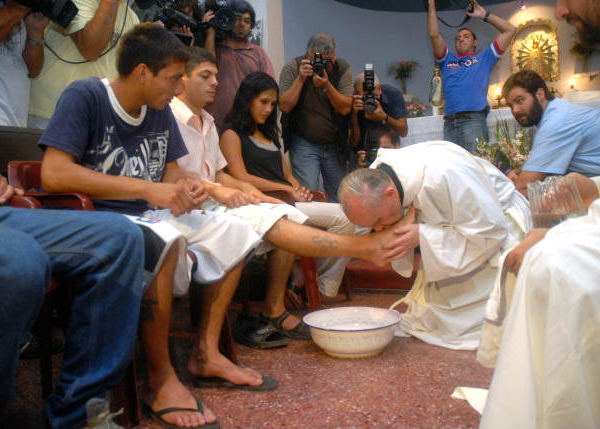
After his election as bishop of Rome, Bergoglio’s assumption of the name Francis was a first clue.  Then when he returned to his Vatican hotel to retrieve his luggage, thank the staff, and pay his bill, we could already see this was a different kind of pope. During Holy Week, he washed the feet of prisoners and of a Serbian Muslim woman.  Think of how shocked we all were that a Pope would act with such humility (then think how sad that this was shocking).  

The intervening months have been filled with captivating stories and photos of his humility and his concern for the ordinary and the outcast among us.  We marvel as he continues to eschew so many of the trappings of power, living simply and driving around Vatican City in a 1984 Renault 4 with 190,000 miles given to him by an elderly priest.

And yet how very fitting that a man who claims to follow Jesus would act with humility, would embrace the poor and the marginalized, would refuse to live within the boxes we’ve created.  Is he liberal? Is he conservative?  Is he traditional?  Is he a radical?  It’s hard to say.  And thank God for that.   These are confusing times to those of us who have invested ourselves in creating and maintaining the order and certainty that comes from hard lines, a monochromatic universe, ‘us vs. them’ paradigms.  For some religious people, he is a dangerous man, one worth keeping an eye on. 

All this just makes me think that in our polarized age, it sometimes seem like the Gospel has become very small, captive to the political, cultural and ideological struggles of our day.  And yet, if the Gospel is truly the good news Jesus proclaimed, then it must, without equivocation, be both relevant and transcendent in this and every age.  

What do I mean by that?  Ideas matter.  Culture matters.  Politics matter.  And the Gospel has much to say about each of these things.  But the Gospel is much too large, infused with too much mystery, freighted with too much hope and longing and meaning and beauty, to ever be fully captured by any ideology, any culture, any political party or national experiment.   If the Gospel is what it claims to be, it is relevant in every age, in every culture, but it is captive to none.  It is transcendent over all.   And if it’s not, it’s just one more idea in the market place, one more ‘way to live,’ one more set of ‘values.’  

Pope Francis seems to know this, to believe that truth is not relative and each generation of Christians has some obligation to steward that which has been passed down to them.  But at this stage of his papacy he is refusing to be drawn into our rigid frames.  And he has decided to emulate Jesus himself by spending time with those on the margins of polite society, resisting the trappings of temporal power, and incarnating a holy love for human kind.  

And so he goes about defending the sanctity of each and every human life; bringing good news to the captive; reaching out to the marginalized, the weak and the vulnerable; challenging the excesses of capitalism and the emptiness of materialism; and all the while holding firm to the orthodox faith handed down from the first apostles.  Attempting to incarnate a Gospel that is both relevant and transcendent. In short, he is leading with love.   

May Advent prayer is that I would find a way to understand the age in which I live and incarnate a Gospel that speaks into it but that also transcends it.  I pray that I would have the discernment to allow the truth of the Gospel to inform my views on politics, economics, vocation, history art, and culture, not the other way around.   And I pray that I would always lead with love. 


Thursday, December 6, 2012

Ceasefire


Since the end of October I have worn a red and black piece of ribbon tied around my wrist with the words “It wont’ stop until we talk” printed on it.  I was asked to wear this by a good friend of mine named Robi, an Israeli mother whose son was killed by a Palestinian sniper while serving at a checkpoint in the West Bank.   I see her often on my frequent trips to Israel and the West Bank, and on this occasion she was with a Palestinian named Bisam whose 10-year-old daughter was killed by an Israeli soldier.  Just after I left them, events there once again dominated our headlines.  Yet it is easy for us to keep the violence at a distance.  We can cheer on “our side” in the conflict, whichever side that is, but this is no sporting event.  When wars are waged, the innocent die along with combatants and perpetrators.  Robi and Bisam have paid a price that is too high for any parent to be asked to pay.  Yet they refuse to demand that the deaths of their children be avenged, nor are they willing to allow them to have died in vain.  Together, and with other Israeli and Palestinian families, they cry out for an end to the violence and for a resolution that recognizes the dignity and humanity of all.  Their message is simple. This conflict will not be solved through rockets and bombs, but only through negotiations. 

To many this sounds naïve.  But as another Israeli friend of mine who lives in a farming community on the Gaza border once told me: it’s those Palestinians who fire rockets on her home thinking she and other Israelis will just go away who are naïve.  And it’s her fellow Israelis who think that if they just bomb Gaza “back into the Middle Ages” as an Israeli cabinet minister has suggested, the Palestinians will just give up and move to another Arab country, who are also naïve.

Both sides have those who look at the brokenness, at the insecurity, injustice, and hopelessness around them and draw the conclusion that violence is the only way.  And while the pessimists may have the facts, those who believe in a moral universe know that their own future is best secured when you take into account the humanity of the other.

No doubt, there are those on both sides who do not want peace at the price of accommodating the other.  They’ve had center stage far too often. These are the maximalists who insist that only their demands are legitimate; justice and security for them is only for them.  But there are Israelis and Palestinians who realize they are neighbors, who understand the other is not going away, and even some who recognize that justice and security for one requires justice and security for the other.   There are those who preference life over death, building over destruction, dialogue and compromise over rockets and bombs.  


Warning sirens, bomb shelters, safe rooms, and rocket attacks have become normal in southern Israel for some time now.  Insecurity is the new normal. These are facts that must not be ignored.  Closure, blockade, isolation, and humiliation are normative for Gazans.  Neither can this be ignored.    

A ceasefire is currently in place, and a true ceasefire was desperately needed, yet if it is not followed up with an attempt to address all activities that perpetuate the conflict (and there are many) and honestly try to resolve them, it will be but postponing the next round.  Because, as my friend Robi says, “it wont’ stop until we talk.”  But the talking has to be accompanied by and lead to action. Core issues have to be addressed, with security, freedom, legitimacy, justice and dignity for all as the aim.  Violence in the Middle East is not a video game.  Real people suffer and die.  If there are any wise leaders here or there they will find a way do the hard work of conflict resolution now while there is calm. 

Monday, September 10, 2012

The Greatest is Love--A 9/11 Reflection

I've always thought this song captured something really important about that day now 11 years ago, the shaping event of a generation. I listen to it from time to time and am convinced that appeal of this song is two things: the way it reminded us of our common humanity, and its core message--that the greatest power in the world is love. Which is not to say that evil isn't real, hatred doesn't have its appeal, innocents don't die, and the world isn't broken. But as Alan Jackson paraphrases the Apostle Paul "faith, hope and love are some good things He gave us, and the greatest is love." As we confront hatred and evil in our day, in whatever form, we should never lose sight of the fact that there is no force more powerful than love.

Thursday, August 30, 2012

The Status Quo Won't Hold


Here's the money quote from "The Rise of Settler Terrorism," an excellent Foreign Affairs piece written by Dan Bynum and Natan Sachs: "Almost everything related to the Israeli-Palestinian dispute involves complex tradeoffs and sorting through opposing and often equally legitimate claims."  No real peacemaking can ever take place without dealing honestly with mutually irreconcilable narratives.  But when we are willing to listen to more than one view of the conflict and treat both with respect, room is created to build a new future on the ruins of a broken past.  

The equally important lesson I draw is the way in which this piece undermines the assumption that the status quo in this long-unresolved conflict can hold.  As a wise American diplomat once said, there is no neutral gear in the Israeli-Palestinian conflict.  You're either moving forward and making progress or you are going in reverse. Lack of progress toward peace strengthens radicals on both sides.  And of course there are those who believe violence is a legitimate means to achieve their goals, but violence begets violence and will bring neither lasting peace or security to either the perpetrators or the victims.   Leaders on both sides must not only be quick to condemn the use of violence, but they bear equal responsibility to be about the urgent business of pursuing peace.   The status quo does not hold, and only by providing a vision for a better future, one that finds a way to accommodate the legitimate rights of two people with deep connections to the land, can those on both sides who desire to live in peace be strengthened and those who would use violence be pushed further to the margins of their respective societies. 

Monday, July 16, 2012

Embracing the 'Radical Middle'


My friend Chris Seiple is a brilliant guy and a very able communicator. He has a preacher’s gift for explaining abstract concepts simply, and he is a keen analyst and observer of the world we live in.   He often describes his work at the Institute for Global Engagement as attempting to create a “radical middle where citizens can be respectfully honest and agree to disagree (when necessary) while maintaining relationships.”  

As someone who is weary of the American culture wars, the deep polarization in our society, and the high levels of incivility in our discourse, I confess I’m drawn to another way, almost any other way, of bringing my deeply held views into the public square.  How do we live with deep differences and at the same time advance a common good?   How do we disagree on principle without demonizing those who hold opposite views?  

To me, this notion of the radical middle is central to navigating some of our thorniest challenges in America today.  And of course among them is one of the thorniest of all:  the Israeli-Palestinian conflict.  Both sides have their partisans and both quickly apply a Hogwarts-like Sorting Hat to all who would dare enter into their club.  Either you are pro-Israel or you are pro-Palestinian, but you cannot possibly be both.  And yet what if this approach has actually helped perpetuate the conflict rather than resolve it?   What if we brought our pro-Israel and pro-Palestinian sympathies into the arena and discovered that they’re not mutually exclusive?  What if we created a ‘radical middle’ that would refuse to be drawn into the conflict but would instead look for constructive ways to end it?  What if to be pro-Israel is to be pro-Palestine? And what if the opposite is equally true?   That’s a radical middle ground that could transform a lot of brokenness both here and there.  


Wednesday, July 11, 2012

A Biography of the Holy City


In reading Simon Sebag-Montefiore’s Jerusalem: A Biography, I am reminded of Winston Churchill’s observation: “No two cities have counted more with mankind than Athens and Jerusalem.”  A city with over three thousand years of history, the story of Jerusalem is deeply connected to its location as a place where East encounters West and humanity encounters God.  Strategically insignificant and lacking in so many of the qualities and natural resources that have historically made a city great, Jerusalem compensates mostly by its proximity to the divine.

And while the divine is never far from Sebag-Montefiore’s grand and breezy survey of the city from the days of the Canaanites until today, his focus is on Jerusalem as crossroads, battlefield, and prize for conquerors.   The indigenous residents of Jerusalem—whoever they may be at any point in time—are rarely more than pawns in larger historical dramas and military campaigns. 

Interestingly, Sebag-Montefiore’s ancestor plays his own role in Jerusalem’s history.  The famous windmill just outside the Old City and behind the King David hotel was built by Sir Moses Montefiore.  Though he’s not always a great storyteller and his book suffers from lack of an experienced editor, for a sweeping history of the much disputed, much desired, much maligned city, Sebag-Montefiore’s book is worth reading.  Some will quibble with his assessments of the modern conflict between Israelis and Palestinians, but he makes a commendable attempt to extend fair treatment to both historical narratives and various points of view.


Saturday, May 12, 2012

Leaving Home

On Easter Sunday in 1997, I entered a place I’d never been before and knew I’d found a home.  At the time, Judi and I had only been in Washington for about four months.  A friend had given me a list of churches to visit and the last one on our list was The Falls Church. Though it was an historic church, predating the American Revolution, I knew little about it nor little of what to expect, but from that first Sunday it was good and right to be there. 

The liturgical worship and the sanctuary were simple, reverent and beautiful.  I felt ushered into the divine presence, directly connected to historic Christian practice and experience.  My first glimpse of the kind of preaching and teaching that came from the pulpit proved to be the pattern year after year:  biblical, relevant, authentic and hopeful.  Our rector, John Yates, understood his calling to require boldness in proclaiming biblical truth but always in a spirit of love and with deep humility.   And it was this love and humility that drew me further in to the truth he was preaching.  

Our oldest two children were with us on that first Sunday.  Abby was 3 and Zach was 8 months old.  We’ve added two more to our family in the intervening years, William and Anna, and all four have grown up in The Falls Church; it’s the only church home they’ve ever known.  They’ve grown in faith and been loved and shaped by devoted nursery workers, Sunday School teachers, youth leaders, and caring members of the congregation.   Week by week, year in and year out, so much of the patterns of our lives has been marked by activities at The Falls Church or with the church family.   Father-Daughter dances, Summers Best Two Weeks, Fusion, Crossroads, Cornerstone, Guys Go Camping, Women’s Bible studies, Shrine Mont and Canaan Valley parish retreats, and Breakaways, have all given shape and rhythm to our lives.  They’ve created community, encouraging, sharpening and challenging us, and they’ve provided places for us to serve each other and the community around us. 

And it has been here that we have also adapted our lives to the rhythm of the historic church calendar, marking the Sundays of Advent, Christmas, Epiphany, the 40 days of Lent, Good Friday, Easter and Pentecost. In particular, I love the reverent Ash Wednesday services in the Historic Church, standing to receive the ashes in the sign of the cross on my forehead and feeling connected to the generations before who have stood on those same wooden floors surrounded by those pristine white walls amidst the simple beauty of a traditional colonial Anglican worship space.   And I love the solemn Maundy Thursdays in the Main Sanctuary softly illuminated in the evening light, walking forward on worn brick to receive the Eucharist around the circular altar before the descent of darkness and the stripping of the altar, then departing in silent reverence, as we go to contemplate Jesus’ passion and prepare our hearts for the joyous celebration of Easter. 

It is The Falls Church that has most deeply connected me to ancient practices infused with living faith and fresh experience.  And it is here that I have been nourished by the regular sustenance of the Communion Table.  The Eucharist remains a mystery to me but I know that the bread and wine are as essential to me as food and water.  I am humbled to both take and serve communion in these beautiful places surrounded by other believers, as we all kneel in common humanity and need, while all around us people are singing or silently praying.   

Just as I was making my way to historic and orthodox faith, some in the leadership of the Episcopal Church were leaving it.  By 2006, most at The Falls Church felt that a fidelity to Scripture and the demands of conscience required our congregation to leave the Episcopal Church.  Much effort was devoted to arriving at an equitable agreement with the Diocese of Virginia and an amiable departure, and all proceeded according to this plan until the national Episcopal intervened and forced the Diocese to bring suit against us.  The legal battle that followed was long, filled with twists and turns, and a drain on resources for both parties.  In the end, we lost, and this weekend we will hold our last services in this historic property.   

This Sunday a few thousand of us will gather to say good-bye to sacred space, and even though all the earth is the Lord’s, surely some places are more sacred than others. And yet we know that this space is also sacred for those from within our congregation who could not leave the Episcopal church with us and who will now be returning, few though they are, to a place rich in meaning form them as well.   Our prayers are that this space, hallowed over the past 275 years as faithful people have gathered to encounter the living God, will continue to be a place where Christ is proclaimed and where his transformative and redemptive power breaks free into a broken world. 

Amazingly, the pain of this transition now upon us has not led to bitterness or rancor, and for that we can at least in part thank our good rector for his 30 years of preaching, teaching and living kingdom values, but also for the way in which he has shepherded us these past few months.   A lesser man could have nurtured ill feelings and resentment but John has shown us by word and example that Christ is faithful when we are not, and that He can be trusted no less in difficult times than in seasons of prosperity.  

As we leave the buildings we do not say good-bye to the church, because, of course, the church is more than the space in which it gathers.  So even though most of us will go with sadness and feelings of apprehension, we are also thankful that it is through such trials that we can grow in our understanding of who God is and how we are to live as his people.   I can honestly say I am filled with hope for the future of our church.  We know that the world we live in is often more like Good Friday than Easter Sunday, but you can’t stop Sunday from coming.   And next Sunday when we gather in a middle school in Arlington, we’ll be without our robes and vestments, our prayer books and communion silver, but we will be together as a family worshipping the same faithful God who is both unchanging and continually making all things new.  May the God we serve meet us there.


Tuesday, February 14, 2012

Implicated People

They came to Washington from across the country, from as far away as the Southwestern desert and California.  Some wore clerical collars and crosses, others skinny jeans, mussed hair, and fashionably slim ties.  They were men and women of good will, representing a broad cross-section of American Christian tradition and expression, along with seasoned activists and policy experts, all united in their commitment to seeing an end to the Israeli-Palestinian conflict.  

Their gathering at an august think thank in Washington, DC, felt like something remarkable.  These are leaders with no interest in dividing the world into sheep and goats based on nationality or ethnicity.  They have eyes to see more than one side of a story, and they came rooted in a commitment to universal human dignity.  They are not blind to injustice, violence and hatred; in fact, each has relationships with real Israelis and Palestinians who bear the consequences of a decades-old conflict.  No, these are not naïve dreamers, just people who have seen too much and have been drawn too deeply in.  They have been drawn into the stories, lives and work of those in the Middle East who refuse to be enemies. And they now feel too implicated to walk away.  

There is a unique power that comes from people who understand all too well how broken the world is, and yet somehow know that this was not how it was meant to be.  As women and men of faith, they are people  who will not give the last word to the cynic, nor cede the field to those who would perpetuate conflict by embracing flawed theologies and divisive worldviews.  They are ambassadors of a message of hope and reconciliation, and each believes a solution remains possible.  Aaron Niequist, a talented musician, songwriter, and worship leader, said it best:  “It will either work for both sides, or it will work for neither.”  And it was in that spirit that they met.  Some were old friends, many met for the first time at this gathering.  Each has a gift and each makes a contribution to the common good, but the beauty of their coming together was the way in which their unity was so much greater than the sum of their individual parts.  And for three days they told stories, asked questions, strategized, and imagined ways they could be better, stronger, and louder advocates and peacemakers.  Strangely for Washington, egos were checked at the door.  No one spoke just because of how much they loved to hear their own voice.  When the last session was over, many lingered, and it felt much more like the beginning of something than the end. 


Sunday, November 13, 2011

A Day on A Hot Border

Maybe the Israeli side of the Gaza border is not where you'd think of going for inspiration on a sunny and mild autumn afternoon, but while sometimes difficult circumstances reduce us to the worst that is in us, sometimes it is in great trial that many find the better angels of their nature.  Today we met two such people.  

Michal teaches history in her local public high school.  No one should be deceived by her diminutive stature (she's clearly under five feet tall)--this is a woman of uncommon strength and resolve. She and her family live on a kibbutz near the northern border of the Gaza Strip in a community that she describes as something of a paradise.  But it's a paradise that has for the past ten years been threatened by missile fire from it's southern neighbors.  In January 2009 Michal watched the last war in Gaza, Operation Cast Lead, not on CNN, but by looking out her living room window.  From an early age, her children have known how to distinguish between an Apache and a Cobra helicopter, and between cannon and rocket fire.  On the sounds of weaponry and explosions, she says sadly, that this is "the background music they've grown up with."

To see her idyllic communal life on the kibbutz so marred by threat and to be forced to live life in a state of constant insecurity is enough to breed hatred, resentment and a desire to punish all who might be complicit. Yet remarkably she has, as an educator, devoted herself helping young Israelis understand that to see history from another's eyes is not to diminish their own story.  A couple of years back, Michal discovered a dual narrative history textbook which was jointly developed by an Israeli and a Palestinian professor along with a team of classroom teachers from both sides, and she began using it to teach a group of high school seniors the history of the past 100 years from both the Israeli and Palestinian perspectives.  Her challenge to the status quo nearly resulted in her school losing government funding, and the book is now explicitly prohibited from use in the Israeli pubic schools (similarly, after a couple of schools in the West Bank agreed to use it, the Palestinian Authority banned it there as well--tragically, this may be the only thing the two governments have agreed to in years).  Undeterred, and fully supported by her the leadership and parents in her school, Michal no longer distributes the textbook, but intends to still teach the class.  She's convinced that both sides don't have to agree to a common narrative, but they do have to learn how to listen to the other and understand that while there may be only one truth, there are often different ways of looking at it.  

Then on to they nearby agricultural community of Nativ HaA'sara where a kindly grandmother with a transfixing English accent welcomes us to her home with a fresh coffee cake.  We sit under an awning on a perfect fall day and listen to the amazing adventure that is the story of her life.  The British born Roni married an Sephardic Jew from Cairo whose family was expelled by Nassar in 1956 and found a home in Israel.  Her husband became an expert in desert agriculture and after Israel's capture of the Sinai peninsula in 1967, the family helped establish a farming there.  They enjoyed their new life in the northern Sinai beyond their wildest dreams, but when Israel and Egypt reached a peace agreement in 1979, the entire village was relocated some 30 miles north just north of Gaza City, but this time definitively inside the internationally recognized border of Israel.  And here they began a second life, much like the first, but first her husband answered his country's call to move to Cairo to apply his expertise in modern farming methods to Egyptian farmers.  This was obviously no easy thing for a man whose family's home and his father's business had been confiscated by a previous Egyptian government, and who had been forced to flee as a refugee some 25 years before.  But in the end he returned and his family followed suit and they spent five years in Egypt where they learned just how difficult peace and reconciliation is at the level of personal relationships.  Upon returning to Israel from their time in Cairo, Roni with no illusions about how difficult it is to achieve, sustain, and nurture peace, but she was more convinced than ever that the road to get there runs through dialogue and mutual respect, not through war and violence.  She has a loving family but none quite agree with her approach, though all respect her commitment. Her son tells her she misreads the situation—that “this is war and we’ve got to hit them back until they give in. The other side only understands force.  You’re dreaming, Mom, if you think anything else will work.”  With her quiet resolve she responds that he’s the one who’s dreaming if he thinks the people of Gaza will just go away and likewise the militants in Gaza are dreaming if they think she’ll go away.   The world of violence and retaliation is no doubt all too real, but she reminds us that there is another way.   And the path to true and lasting peace begins by being willing to consider the humanity of the “other.”   With a cool breeze blowing from the surrounding desert, Roni speaks to us form her home just 3km from Gaza and says about the people there:  “I want to treat them like I treat my neighbors, because they too are my neighbors.”


Wednesday, October 26, 2011

Faith and Human Rights


Do faith leaders and secular human rights activists have anything in common?  Earlier this month, we decided to find out.

For some in the human rights community, religious people are narrow minded, intolerant, and part of the problem

For some in the faith community, human rights activists are moral relativists, naïve secularists, and dismissive of transcendent truth.

Fortunately, none of those we brought together were in either of those camps.  It was a unique gathering of people of good will from both communities exploring new ways to work together and to increase collaboration in support of peace and justice for Palestinians and Israelis.

Those of us who still seek and hope for a political solution to end the conflict are a pretty discouraged lot at the moment.  But our work at Telos is predicated on the view that there is a direct link between peace, justice, and security and that this conflict will not be solved until we take seriously issues of human rights and the inherent dignity of every Israeli and every Palestinian. 

To the American Christian leaders who met with us, this conflict takes place half a world away, but they’ve found themselves strangely implicated in it.  And they’ve found it’s in some ways as divisive here at home as it is there.  The human rights activists who gathered are accustomed to working in a world that is mostly secular, but they have seen the impact, both good and bad, that American faith communities have on their own community and on their work.  And they came because they hope it can be a force for good.   And let me assure you, it can be.   It isn’t always a force for good, but it can be.  Religious faith has been an animating force in America from the beginning.

Take the issue of race in America.  As Secretary of State Condoleezza Rice has so often said, America was born with a birth defect.  Our Founders created a system that aspired to respect the inherent dignity of all humanity and yet went on to enshrine the disenfranchisement of most adults and condemned millions to lives of slavery and cruel subjugation.

The movement to abolish slavery was largely born in churches, led by faithful Christians, and fueled by the demands of faith to love justice and literally set captives free.  And it was a devout Christian woman with a deep faith and a gift for storytelling who wrote a book called Uncle Tom’s Cabin that became an unprecedented bestseller.  It told the story of the horrors of slavery from an unabashedly religious point of view and it both inspired and offended in equal measure.  So much so that when Mrs. Stowe met President Abraham Lincoln he said “So you’re the little lady who wrote the book that started this big war.”  Harriet Beecher Stowe had seen too much and felt too implicated to remain silent and she and her fellow abolitionists helped change the American story. 

Of course the history of race relations in America is a long and complicated story, but let’s skip ahead to the 20th century where we find an entrenched system of legal and societal separation nearly 100 years after the freeing of the slaves.  And as men and women began to push back against the oppression and the gross injustice, a movement was born that we now call the Civil Rights Movement.  And it spokesman became Dr Martin Luther King, a Baptist pastor whose deep Christian faith compelled him to preach a form of resistance that was ennobling to both the black man and the white man.  King actually listened to and lived what Jesus said as he refused to hate his enemies.  And he had real enemies. 

This movement was born and nurtured and given voice in the black church.  And it stood so firmly on the moral high ground that it was joined by Northern white Christians and by many Jewish Americans and by legions of nonreligious people all who also believed in justice and human dignity and freedom.  And this movement, which transcended race, class, and culture, also changed the American story. 

In our gathering we brought together a micro cosmic group of Israelis and Palestinians who have been unable to ignore the problems in their own societies and they are each trying to change their stories. 

And we invited faithful American Christian leaders and other activists who see that the things that happen so far away from us concern us and divide us here at home.  All know the way in which America is a part of the Israeli story and the Palestinian story and they came because they want to change our story and at the same time change theirs. 

The religious landscape in America is very diverse, and this gathering in no way represented that diversity.  But within all the major strains of American Christianity there are tremendous opportunities for constructive engagement.  Catholic social justice teaching is a rich and deep well to be mined in support of peacemaking, as is the history of social justice activism by Mainline Protestant churches.  In many ways, American evangelicals have been the problem children on this but that is changing and there is tremendous opportunity for further change as well as important theological resources to tap in to.

And there is a long history to draw on from each group of advocacy for abolition and civil rights, prison reform, orphan care, and in addressing topics like homelessness, disease, environmental degradation and the like.  Faith remains a potent force in American society and the potential for collaboration between these two communities is strong.  And as people committed to the inherent dignity of all, our ability to write a new story for ourselves and for the Israeli and Palestinian people is great.

Thursday, September 29, 2011

From the Paris Express

http://www.paris-express.com/articles/2011/09/28/news/news3.txt


THURSDAY SEPTEMBER 29, 2011 Last modified: Wednesday, September 28, 2011 8:02 AM CDT
Grist called an 'excellent' County Judge
Friends and co-workers remember Bill Grist as an "excellent" County Judge.

Grist, 79, died last week and funeral services were held Saturday at St. Benedict Catholic Church on the grounds of Subiaco Abbey.
Grist served as Logan County Judge from 1991 until 1998.

Early in his tenure as County Judge, Grist was instrumental in setting up the county's 911 emergency notification system.

"He started out on a mission and that was to set up the 911 system," said Jill Sewell, who was 911 coordinator during Grist's eight years in office. "He was very proud of that accomplishment."

Betty Fairbanks, director of the county's Emergency Medical Service, said Grist was a strong supporter of the service.

"I was hired by Bill Grist," she said. "He was an excellent boss and very pro-EMS. He did everything he could to help us. He helped build our ambulance fleet and get the new equipment we needed. He was a good man to work with and was very likeable. I considered him my friend, as well as my boss."

Logan County Judge Gus Young said Grist was one of the first people to come to him and offer help when he was elected to the job.

"He offered me any advice I needed and I really appreciated that," Young said. "We are still getting benefits from some of the things he did as County Judge. There are several bridges in the county that we're still using because Bill Grist saw to it they were repaired."

Linda Core, who served as Logan County Clerk when Grist was judge, said last week that he took care of the county's finances quite well.

"He was an excellent County Judge and a good steward of the county's finances," Core said. "He really made it a point to get along and work well with other county elected officials."

Charlotte Davis, who served as County Treasurer during the Grist years, remembered him as "a very good businessman and a very fine gentleman."

Logan County Circuit Clerk Everly Kellar said Grist had personals qualities that endeared him to many.

"He was a wonderful judge and a wonderful person," Kellar said. "We all thought the world of Judge Grist."

In addition to serving as County Judge, Grist was very active in the county's Democratic party and served for a time as party chairman.

"He was a force for the Democratic party," Core said. "He stirred interest on the county level and he made it a point to know people on the state level."

Current county party chairman David Rush remembers Grist as someone who was very good about helping the Democratic party and about rendering service to the area.

"As far as someone who gave his time to benefit the area, I don't think he can be surpassed," Rush said. "His whole life was service to his country and his state and his county. There's nobody in the county who could take his place."
Close Window [x]

Goodbye to a good man...for now

The following is a eulogy I delivered last Saturday at the funeral mass for my father-in-law, William C. Grist.  He served his country in the Air Force, federal civil service, and as the County Judge in Logan County, Arkansas.  A devoted wife, five children and a host of in-laws, grandchildren, great-grandchildren and friends mourn his passing.  Today would have been his 80th birthday.

I didn’t know Bill when he was a farm boy here in Logan County wearing underwear made from flour sacks, though I’ve heard lots of stories. Nor did I know him when he was a young US airman in Tripoli before Ghadaffi, or in Germany, or when he did two tours of duty in Vietnam, but I’ve heard good stories about those, too. I came into the family after the adventure and the wonders of an Alaska experience that predated statehood and shaped his family’s love for the great Northwest.  I missed the years at GSA in Auburn and met Bill first in retirement here in Paris. 

When Judi brought me home to “meet the parents” I didn’t end up in a basement room hooked up to a polygraph machine as in the movie with Ben Stiller and Robert DeNiro.  But I did end up on that first night at Grandma Gracie’s house for a supper of deer meat and a chance to meet the whole larger ‘Grist” family.  Harold and Cecil and Lila Mae were all there and so was Snooks.  And can I just say God bless Snooks who has been such a faithful friend and brother, but especially in these last months. And the same goes for Reggie, Pat and Bills 6th child.  Some say Reggie is the problem child, but some say he’s the favorite.  Anyway, on my first night meeting the family, I was at a place where everybody told jokes and tall tales and laughed and where they all called him “William.”

One night not long after Judi and I got married, I was at home in NWA watching the local news on the little 12 inch television Bill and Pat had given us and the news anchor led in to a story from Logan County about a local charity event in which some of the prominent local men were dressing as women and participating in a “beauty-less” pageant.  No sooner had they announced the premise, when I yelled “Judi you’ve got to see this---your Dad is on TV!”  And there was Bill in a long gown and heels, wearing a wig and waving gamely at the camera with a flirtatious smile.  Now Bill was a handsome man, but he was a really ugly woman so when we called to tell him we’d seen him on TV it was no surprise to find out that he won first prize.

I did know him when he decided to abandon retirement to run for Logan County judge.  Judi and I came here on many Saturdays and stood in front of IGA or Wal Mart in Paris or Booneville and handed out campaign literature asking people to give him their vote. And though he was as yellow dog a Democrat as my own father, he was willing to look the other way and let a Republican campaign for him. This was a cause I believed in—Judi and I knew he’d be a great county judge, and he was.  I am sure that neither before nor since has anyone done better at wisely stewarding the county’s resources and no one has been more committed to serving the public good.  And he kept that job until it just interfered too much with flying and fishing and his and Pat’s ability to hit the road in their camper to see family in the Northwest and in DC.

Bill loved his family.  I’ll never forget the example he set when Pat was sick a few years back, the way he cared for her and the concern he showed for her health and well-being.  And of course the way she has returned the favor has inspired us all.  God bless you, Pat.  

And he loved his children.  Even though we’ve all been separated a lot by distance and circumstance, I always felt like I knew a lot about all of Judi’s siblings and in-laws.  And maybe more than anything else, I knew about Eddie’s life as a pilot, the current aircraft in the fleet he supervises, the places he was going and where he’d be in the days ahead.  Yes, we all know lots of stories about Eddie

He was good to all his sons-in-law and his daughter-in-law, too.  And I think from speaking to any of us you’ll see the degree of love and affection we each felt for him.  When Frank toasted him at last weekend’s wedding, we were all in tears.

But I want to speak for just a moment to his grandchildren.  As evidenced from the things you’ve said, from your Facebook postings, and from things like the look in the faces of my own children when I had to bear to them the painful news on Wednesday morning that Grandpa had left us---you loved him and you knew how much he loved you.  He joked with you and had fun with you.  He told you so stories that you were never quite sure whether to believe or not.  But he also prodded you to do your best, to become responsible citizens and productive men and women, to make the most of your opportunities.  You know how much he cared about your good grades and your achievements.  He did that because he wanted what was best for you.  And you in turn honored him with your love and affection.  Only last week we celebrated Alyson and Bryce’s wedding in Washington and it was of course no coincidence that Alyson chose to get married on Sept. 17, Bill and Pat’s 56th wedding anniversary. She so loved her grandfather that she had asked him to officiate the ceremony.  Each of you loved and respected him and you knew he loved you. That’s a gift which can never be taken away from you for the rest of your lives.


Wednesday, September 21, 2011

Presentation at The Gathering

Last week I had the privilege of participating in a panel discussion about Middle East peacemaking at a conference in Florida.  My remarks follow: 

The elusive task of peace in the Middle East has been the focus of my attention for a long time now. While serving at the State Department in the post 9/11 era, I spent a good amount of time in the Middle East, and my work began to center on the Holy Land where, as we all know, Israelis and Palestinians have been fighting for more than 60 years over who controls the land.  There’s too much history to tell it all, so I’ll just begin with my first actual visit t to Jerusalem which was during the Second Intifada, which was a violent Palestinian uprising against Israeli military occupation that was wreaking havoc on both Israelis and Palestinians.  Hundreds of Israeli civilians died as suicide bombers blew themselves up in cafes, shopping malls and on public buses.  Even more Palestinians died in the Israeli military response. 

I arrived in Jerusalem amidst the violence and the chaos to see the Israelis building a security barrier as a means of self-protection, the first priority of any State.  But I also saw the way in which some were using the justifiable response of erecting a physical barrier as an opportunity to demarcate a political boundary in sensitive places. 

The 24 foot high concrete wall snakes its way through Palestinian neighborhoods in E Jerusalem in ways that separate families and cut off communities from jobs, healthcare, access to churches and mosques, and from historic patterns of life. And I was of course troubled when I saw graffiti on the wall that read “Bush’s Wall” and “Made in the USA.”  

I spent several days there, learning more firsthand about the issues I’d only read about, and then and on the many visits since then, I spent time with the real people who live there

What I found was a complicated geopolitical conflict, one that included

·      two competing national narratives
·      three historic religions with claims on sacred space
·      a complicated history littered with too much bad leadership and too many missed opportunities
·      a cycle of violence and a belief in the necessity of revenge, because to not respond is to demonstrate weakness
·      high levels of fear and insecurity
·      indefensible amounts of injustice
·      a general sense of hopelessness, cynicism and despair
·      a beleaguered but vitally important Christian presence
·      a large American role.

The role of the American government is indeed a significant one.We provide $3B/year in military support to Israel, and we are also the largest contributor to the Palestinian Authority.  And we are the de facto authors of international policy vis-à-vis the conflict

As for the American church, I found two dominant approaches:  To put it in oversimplified terms, there are strong expressions of the evangelical church which are so desirous to affirm the State of Israel and the Jewish people that they ignore the reality of the Palestinians, including the historic Palestinian Christian community

Likewise, there are those mostly in Mainline Protestant churches who so seek to identify with Palestinian dispossession and suffering that they end up delegitimizing Israel.

Neither of these approaches, though in many cases well intentioned, serves the cause of peacemaking nor sees the links between justice, peace and security. 

And having met so many of the real Israelis and Palestinians who live there, I’ve come to the conclusion that both these approaches fall short of being an authentically Christian response to people caught up in a geopolitical conflict.

And yet I also met some of the most inspiring advocates of peace and justice you could ever know. Some were Israelis, some were Palestinians.  Some were Christians, some were Jews, some were Muslims, many were entirely secular.  And some became both friends and heroes to me.

Let me tell you about a couple of friends of mine. 

The first is Danny, an American-born Jew who made aliyah to Israeli 40 years ago.  Danny is a proud Zionist who has served as an officer in the Israeli army and who has had two daughters who’ve performed service in the IDF as well.  Danny’s own family history surely have shaped his commitment to the necessity of a safe and secure homeland for the Jewish people: His father was born in Germany and, thanks to a renegade American consular official who was willing to ignore the rules, managed to escape the Third Reich in around 1940.  He made his way across Russia, through Japan, and ended up in Seattle, Washington, where he graduated high school, then before the war was over Danny’s father found himself back in Germany, but this time wearing an American uniform and fighting the Nazis.  Danny is a lawyer who has basically abandoned his practice as he devotes himself to the work of creating a Jerusalem that is respectful of the deep and historic connections of three faith communities and two national narratives.  He works tirelessly for fairness, justice, compromise, and peace for both peoples. 

And then there is my friend Daoud, whose name means David in Arabic.  Daoud is a Palestinian Christian who was in fact born in the City of David.  His family has a farm on a hilltop just outside Bethlehem in an area that is now home to thousands of Israelis who since 1967 have built towns known as settlements on all the adjacent hills.  Daoud’s farm land is coveted and several attempts have been to take it by force, but because he has Ottoman-era deeds to the property he has been able to maintain control of the property through a protracted series of court cases.  But while he retains control of his land for now, he is not allowed to erect any kind of structure on the property, nor is he permitted electricity or running water.  Daoud is a committed follower of another son of Bethlehem, and has been forced to determine if all those things said about forgiveness and loving your enemies is real or impossible nonsense.  He’s decided to take Jesus commands seriously and he lives his life in this way.  At the entrance to his farm, you’ll find stone with these words etched into it’s face:  We Refuse To Be Enemies

And since that time I have felt implicated in this conflict, both as an American and as a Christian. But what I soon discovered, perhaps the most difficult challenge is finding out how to act in ways that don’t make the problems worse.  First do no harm.  

Most Americans, and particularly most American Christians, have felt compelled to take a side in this conflict.  Most Christians identify with the Israelis on a number of fronts:

·      a shared biblical and religious heritage;
·      a sense that the creation of the modern State of Israel is necessitated after centuries of European anti-Semitism which culminated in the horror of the Holocaust;
·      a view that the Israelis are underdogs and vulnerable allies in a sea of hostile neighbors;
·      and a belief that Americans and Israelis share a similar commitment to democracy and Western values. 
·      and for some, a theology of land, covenant, and end times prophecy;

So assuming for a minute all or much of this is true, where does that leave the other indigenous people group in the land, the Palestinians?  Contrary to what we may have been told the early Zionists who came to their ancestral homeland in the late 1800s and early 1900s did not find “a land without a people for a people without a land” as the slogan goes.  The overwhelming majority of those living in the Holy Land for many centuries were Arabs, both Muslims and Christians. Some 700,000 of them were displaced in 1948 when the State of Israel was created, with over 400 Palestinian villages being entirely abandoned or forcibly depopulated.   And today while the Israelis rightly and joyfully celebrate their independence won in 1948 and their many achievements since, the Palestinians commemorate 1948 as what they call their nakba or their great catastrophe. 

Subsequent wars followed the one in 1948, and in the intervening years many have suffered and died on both sides.  Both have missed opportunities, and both have their maximalists who can’t imagine the possibility of a shared future and whose deepest desire is the other would be driven from the land;

In short, in different ways both sides have suffered and are suffering the effects of a geopolitical conflict.  And if this is true, to borrow from Francis Schaeffer, how now shall we live?

Well, since I’ve been bold enough to suggest it’s absence, I think we should consider what a truly Christian response looks like.  Allow me to offer four points:

1.   An authentically Christian response understands the human condition. This means two things:  First, are all sons of Adam and daughters of Eve. We can neither be naïve about human nature nor about the consequence of the Fall.  Evil is real and can’t be wished away or safely ignored.  But second, we must affirm the dignity of created life.  All the people of the region are made in the image of God and thus share an inherent dignity.  The very lives of both Israelis and Palestinians are sacred to God and real cries for peace, justice and security can’t be ignored.

As University of Virginia professor Charles Marsh has put it:  “vivid realism about the human condition is more honest and clearly drawn against horizons of grace”

2.   An authentically Christian response refuses to choose a side.  To choose a side is to become a party to the conflict.  In our work at the Telos Group, we routinely take small groups of religious leaders on unique trips to the Holy Land in which we expose them to both people, their history, their culture, and to all three faith communities, but in particular to the church on the ground.  We often drive to Haifa in the north of Israel to meet with Abuna Elias Chacour, the Melkite Archbishop of the Galilee, and Abuna Chacour tells each of our groups the same thing:  “If you came here to be pro-Israel that’s fine, but don’t do it at the expense of the Palestinians; and if you came here to be pro-Palestinian, that’s good---we would welcome your solidarity, but don’t do that at the expense of the Israelis.  When you choose one side to the exclusion of the other, you are becoming a party to a conflict that’s been going on for a century, and we don’t need any more partisans in the war.”

I would say that you can’t be pro-Israeli without being pro-Palestinian; and you can’t be pro-Palestinian without being pro-Israeli. It would so much easier if the dividing lines between good and evil were geographic, ethinc, or religious lines, but as Alexander Solzhenitsyn reminds us, the line between good and evil runs through every human heart.

3.   An authentically Christian response partners with and supports those pursuing peace, justice, and reconciliation.  In spite of what you see in press accounts and in political debates, there are people on both sides who are doing the hard work of trying to figure out how to end the conflict and live in peace.  Some do the work of reconciliation; some focus on coexistence; some are advocates for justice, or for the poor; these are true peacemakers; And almost all of them are incredibly inspiring.

We should encourage them, support them, and partner with them when we can.  And we should avoid at all cost undermining them by ignoring the reality they’re pushing back against.

To do this requires committing ourselves to the gritty work of peacemaking.  Not the Rodney King why-can’t-we-all-just-get-along kind, but the kind that acknowledges differences, deals with issues of justice, forgiveness, and reconciliation, and affirms the dignity of all.

4.   An authentically Christian response is eschatologically sound. Let’s get our eschatology right.  I’m not a theologian and don’t pretend to be, but as Eugene Peterson reminded us this morning, what we think about the end helps shape how we live and act today.

This is not to say we can’t have different views about how to read Ezekiel, Daniel and John’s Revelation, and I’m not taking sides between a- pre- and post-millenialists. But if we believe that violence, war and bloodshed in the Middle East is predetermined and necessary and even a good thing, we need to balance that out with what Jesus taught us from a sermon he gave on a Galilean mountaintop.  Our views of Christ’s return should not prevent us from taking up the mandate to be peacemakers and advocates for justice. How authentically Christian is any theology that, when applied, makes us more perpetuators of conflict than agents of reconciliation?  

This is not easy work.  But as a people called to practice forgiveness, to love enemies, to be passionate for justice, to be renewers and rebuilders in a fallen world…

To be a people who believe in common grace for the common good and the flourishing of all, to be heralds for a kingdom that has come and that is coming, how can we do any other?   This to me is what it looks like to pray and work for the peace of Jerusalem.
        
I’m not suggesting that we have it within our power to bring peace to the Middle East, but if we commit ourselves to this work we can help reshape the environment in which this and other conflicts take place in a way that is conducive to the creation of flourishing societies.